
Megaprojects and the Vanishing Public Hearing
Balanced Economic Development series — Part 3 of 3. How can an Economic Development Commission turn investment into lasting local prosperity while protecting quality of life and the community’s ability to shape its own future?
Part 1: Beyond the Build-Out Trap · Part 2: The Leapfrog Advantage · Part 3: Megaprojects and the Vanishing Public Hearing
The video autoplayed while JJ was supposed to be doing something else. A reporter stood on a two-lane road in coastal Louisiana, marsh grass bending behind her, explaining that the state had already passed the laws. Not proposed. Passed. A company could launch rockets over these homes — dozens a day, eventually — and the people who lived here couldn’t sue over the noise, the smoke, the shaking windows. Couldn’t get a judge to pause it. Couldn’t even read most of the paperwork; the records had been sealed, and many of the lawmakers who voted had signed nondisclosure agreements.
He set down his fork. Hundreds of miles north, in his own county, a folder sat on his desk with a data-center prospect in it — the one the task force had been so excited about. Water, power, the fiber loop. He’d spent months teaching himself to ask the hard questions: What’s in the community benefit agreement? Who pays for the new substation? What happens to our aquifer in a dry August?
Now he wondered whether the questions would even get asked. Because the pattern on his phone wasn’t really about rockets. It was about a decision that had already been made somewhere else, by someone else, before the first public hearing could be scheduled. Exempted. Streamlined. Fast-tracked. All the words that meant the same thing.
JJ picked the fork back up, then set it down again. He was an economic developer. He was supposed to want the big project. So why did the video feel less like good news and more like a warning?
This series began with a distinction between build-out and development (Part 1), then showed how a county can grow capability from the inside (Part 2). This final piece turns to the big outside offer itself. Megaprojects — the data centers, spaceports, and hyperscale campuses now reshaping rural America — can be good deals for the places that host them. But they increasingly arrive with something extra tucked into the deal: a legal shield from the environmental rules, water rules, records laws, and public hearings that used to apply to everyone else. Judging whether a project is good for a community, and making sure the community gets a real say in the answer, has become essential work for any local leader.
Megaprojects and the Vanishing Public Hearing
The clearest example is the one JJ was watching. In August 2026, SpaceX announced “Starbase Louisiana,” a $100 billion spaceport on about 125,000 acres of coastal land and marsh near Pecan Island in Vermilion Parish. The company plans to begin construction in 2027, says the first Starship could fly from the site as early as 2029, and envisions eventually supporting more than thirty launches a day. It projects 3,000 to 10,000 permanent jobs, with most hires drawn from the region.
What made the deal possible was a package of seven aerospace bills that Governor Jeff Landry signed by the end of June 2026. Act 874 bars nuisance, trespass, and similar claims over noise, sonic booms, vibration, smoke, light, and “any other disturbance” from launches against an aerospace company that owns and occupies at least 20,000 contiguous acres in the state; it exempts gross negligence, intentional acts, and violations of an FAA license. Act 343 bars injunctions against aerospace flight activity and creates an early “special motion to strike” that can end a lawsuit at the outset, with the loser paying attorney fees. Act 101 shields most state and local records about aerospace projects — plans, technical data, operations — from public-records requests. Other acts opened the state’s industrial property-tax exemption program and sales-tax rebates to aerospace. Records later obtained by the Gulf States Newsroom showed that many state lawmakers had signed nondisclosure agreements tied to the project, code-named “Project Osprey.”
The same pattern runs through the data-center boom, with server racks instead of rockets:
- Louisiana, again. Meta’s Hyperion AI campus in Richland Parish already has three gas-fired plants approved by the Louisiana Public Service Commission in 2025. In 2026, Entergy Louisiana asked for seven more — ten in all — and asked regulators to fast-track the review and skip parts of the usual process, including independent analysis meant to protect customers. The commission adopted an expedited schedule in April, with a final vote expected in December 2026.
- Federal permitting. Executive Order 14318 (July 2025) directs federal agencies to speed permitting for data-center projects that add more than 100 megawatts of load or commit at least $500 million, including through new categorical exclusions from detailed environmental review under the National Environmental Policy Act, and it offers federal sites for development. It applies wherever a federal permit or federal land is involved.
- Spaceports nationwide. On July 30, 2026, the FAA proposed a standing rule that would waive thirteen federal statutes — including NEPA, the Endangered Species Act, the Clean Air Act, the Clean Water Act, and the National Historic Preservation Act — for commercial launch and reentry licenses. The waiver would be a blanket rule, not a case-by-case decision. Public comments closed August 31; the rule is not yet final.
- Utah. The proposed Stratos hyperscale campus, covering roughly 40,000 acres of Box Elder County, was advanced in April 2026 through the state’s Military Installation Development Authority (MIDA). Governor Spencer Cox and the developer have defended it as a matter of national security in an AI race with China — a framing that tends to end debate rather than open it. Residents’ referendum petitions were rejected as not referable, and a separate lawsuit argues that residents were denied any real voice. Both disputes are now in court.
Different projects, different sponsors, one recurring move: exempt the biggest project from the rules, and from the room where the rules get argued.
Fact and Fiction: Which Fears Hold Up
Fear travels faster than nuance, so it is worth separating the concerns that are well founded from the ones that are exaggerated. A community that cries wolf loses the argument it should win.
The founded fears are real and documented. The resource strain is not hypothetical: according to Lawrence Berkeley National Laboratory, U.S. data centers directly consumed about 17 billion gallons of water in 2023, roughly triple their 2014 use, and a single large facility can use up to five million gallons a day. The Electric Power Research Institute (EPRI) estimates data centers use 4–5% of U.S. electricity today and could use 9–17% by 2030. Gas lock-in is a genuine risk when utilities build new fossil plants largely for a single customer, leaving decades of costs on the books if that customer’s demand shifts. And the loss of legal recourse in Louisiana — no nuisance suit, no injunction, sealed records — is not a rumor. It is the plain text of the statutes.
But some of the loudest claims are overstated, and being honest about that is what gives the founded fears their force. The federal government is not overriding your county’s zoning: EO 14318 speeds federal permitting and offers federal land, but it leaves state and local land-use and utility authority in place. Florida’s SB 484, signed in May 2026, explicitly preserves local governments’ power to deny data centers or impose stricter standards. Nor does every data center spike every neighbor’s power bill. A 2026 analysis by the consultancy E3 found that the states with the largest load growth, Texas and Virginia among them, saw some of the smallest rate increases, while states with shrinking demand, such as California and New York, saw some of the largest. State averages don’t settle what happens on a particular utility’s system, though. That depends on the tariff, and on who pays for the new plants and wires. The picture is real strain plus real complexity, not a simple villain.
The Case for Investment — and for Speed
It would be unfair to treat the exemptions as nothing but a giveaway, because their defenders make a serious argument. These projects are enormous, mobile, and impatient: a hyperscaler or a launch company weighing a dozen states will not wait three years for a sequence of reviews when another state offers eighteen months. In that view, speed is competitiveness, and the capital and grid investment that follow a $27 billion or $100 billion commitment are real. There is also a genuine national-security case: AI compute and launch capacity are strategic assets in a contest with China, and a country that litigates every megawatt may lose to one that does not. Proponents point to construction booms, expanded tax bases, and infrastructure a rural county could never fund on its own.
None of that is fiction, and a well-structured project can be a good deal. It can pay its full cost on the grid, live within enforceable water limits, buy from local suppliers, train local workers, and leave the county’s tax base stronger after abatements. The honest question is not whether these projects have value. It is whether capturing that value requires switching off the public’s voice, and who in the host community actually receives the value once it arrives.
JJ’s Megaproject Scorecard
Somewhere in those months of asking hard questions, JJ started keeping a scorecard, a way to hold the promise and the price in the same frame. It works one level below the Pi-AIMIT™ model at the heart of Pi-Regional™. AIMIT asks whether an industry fits the region, and which company within it deserves priority. The scorecard asks whether this deal, on these terms, serves this community. He sorted it into three bands. The first two mark each row as short-term (mostly during construction) or long-term (for the life of the project). The third band covers decisions made once, at the start, that govern everything after.
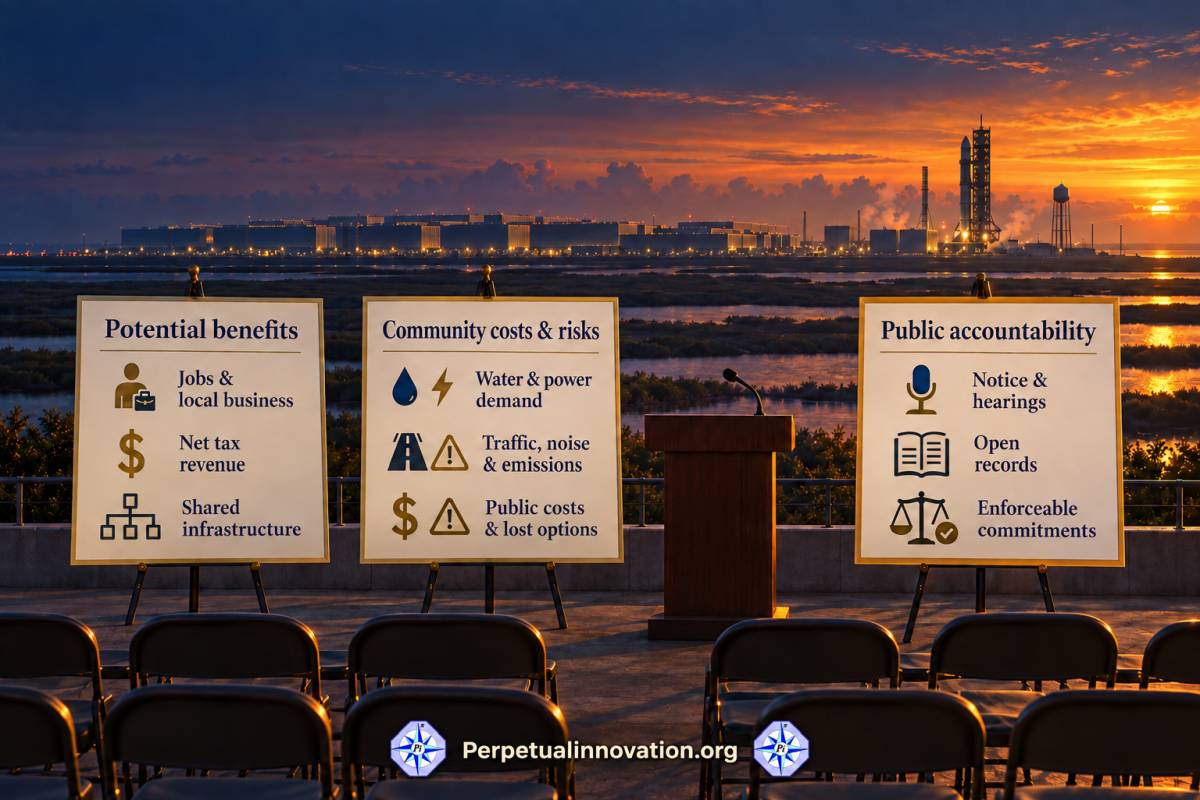
Potential local benefits — rated 1–5 in $
| What the host community could gain | Term | Upside |
|---|---|---|
| 👷 Construction jobs & local spending | Short | $ $ $ $ |
| 💰 Net tax base, after abatements & new public costs | Long | $ $ $ |
| 🔌 Shared infrastructure: grid, fiber, water upgrades others can use | Long | $ $ $ |
| 💼 Permanent local jobs & local supplier contracts | Long | $ $ |
| 🎓 Training, local compute access & community funds | Long | $ → $ $ $ $ (only if contracted) |
Community costs and risks — rated 1–5 in ⚠
| What the host community could pay | Term | Risk |
|---|---|---|
| 🚧 Construction strain: traffic, housing pressure, public services | Short | ⚠ ⚠ ⚠ |
| 💧 Water strain & aquifer depletion | Long | ⚠ ⚠ ⚠ ⚠ |
| ⚡ Electricity demand & ratepayer risk | Long | ⚠ ⚠ ⚠ ⚠ |
| 🔊 Daily life: noise, light, landscape, emissions | Long | ⚠ ⚠ ⚠ |
| 🏭 Gas lock-in & lost options for land, water, and power | Long | ⚠ ⚠ ⚠ |
Public accountability — risk if missing, rated 1–5 in ⚠
| What decides whether the deal is fair | Risk if missing |
|---|---|
| 🔇 Public notice & a hearing before terms are set | ⚠ ⚠ ⚠ ⚠ ⚠ |
| 📄 Open records: energy & water draw, deal terms, no NDAs | ⚠ ⚠ ⚠ ⚠ ⚠ |
| ⚖️ Legal recourse: the right to sue or seek an injunction | ⚠ ⚠ ⚠ ⚠ |
| 📝 Enforceable commitments: CBA, clawbacks, cost-of-service | ⚠ ⚠ ⚠ ⚠ |
Regional and national strategic value is real, but it mostly lands beyond the county line, so JJ doesn’t count it as a local benefit.
These ratings are JJ’s judgments about a fast-tracked megaproject, not measurements, and the columns don’t subtract into a single score. The shape of the ledger is the point. The biggest dollar signs are short-term. Most of the long-term benefits depend on terms someone has to negotiate. The heaviest warnings sit in the accountability band, because that band decides how all the others turn out. With a full hearing, open records, and an enforceable benefit agreement, several long-term risks shrink and the “only if contracted” row fills in. Without them, the community takes on the long-term costs and leaves the long-term benefits to chance. And because Pi-Regional runs on a cycle of measuring and regenerating, every promise in the benefit column should be written so it can be measured later, with clawbacks if it isn’t met.
The Real Cost Isn’t the Project — It’s the Process
Here is the argument at the center of this piece: when a community exempts a project from debate, it does not merely risk environmental harm. It gives up the one moment of leverage it will ever have. The public hearing, the environmental review, and the permit condition are not just hurdles. They are the points where a community can secure a community benefit agreement, a cost-of-service guarantee so residents don’t subsidize the load, a water-use limit, a workforce commitment, a local supplier program, or reserved local compute. Skip the process and you lose more than protection. You lose the negotiation, and the deal is simply handed to you on terms written elsewhere.
This is also where the Food-Energy-Water-Compute Nexus comes back to bite. Adding compute, and now launch infrastructure, as a fourth claimant on the same land, energy, and water only raises the stakes of getting the terms right. The exemptions remove accountability for exactly the resources the nexus says are most contested. A regenerative approach to innovation, the kind the Perpetual Innovation™ framework argues for, treats the community not as an obstacle to be cleared but as a party to the deal. Innovation that requires silencing the people who host it is not strategy. It is extraction wearing a hard hat.
What Communities and EDCs Can Still Do
The good news for JJ, and for the leaders reading over his shoulder, is that the room has not disappeared everywhere. Local zoning authority largely survives the federal orders, and in 2026 states pushed back about as fast as others fast-tracked. By mid-July, state legislatures had introduced roughly 375 data-center bills. The results are mixed, which is itself instructive:
- Maine’s legislature passed the nation’s first statewide moratorium on large data centers in April 2026. Governor Janet Mills vetoed it, largely because it would have blocked a data center planned for a former paper mill in Jay, and the override failed.
- South Dakota’s “Data Center Bill of Rights for Citizens” (SB 135, effective July 1) requires large data centers to pay the electricity costs fairly attributed to them, adds water-use rules, and bars the state from preempting county and city data-center ordinances.
- Florida’s SB 484 makes large data centers bear their full cost of service and protects aquifers. By August, about nineteen Florida cities and counties had paused or restricted new projects while they wrote rules.
- Massachusetts (September 8) now requires data centers above 25 megawatts to file a community benefit agreement with the host community before state permits advance, and bars state agencies from signing NDAs with developers.
- Virginia (Executive Order 22, September 18) moves to end by-right approval for data centers above 25 megawatts, requires local approval, and bans NDAs for state employees, boards, and commissions. Legislation is to follow in 2027.
- Congress: the House passed the Ratepayer Protection Act 417–3 on September 16, directing states to consider making large loads pay their own grid costs. Its path in the Senate is uncertain.
An economic development commission that wants both the investment and the trust can:
- Insist on a public hearing before any term sheet is signed, not after. The sequence is the whole game.
- Make a community benefit agreement the price of entry: cost-of-service protection for ratepayers, enforceable water limits, workforce pipelines, local supplier commitments, and reserved local compute.
- Demand disclosure of energy and water draw, and refuse deals whose paperwork is sealed from the people who will live beside them.
- Measure the deal against quality of life (bills, water, noise, traffic, housing, services), not just jobs and assessed value.
- Use the local authority that still exists, including zoning, permitting, and intervention in utility cases, rather than assuming it has already been preempted. Check what your own state allows. The tools differ, and they are changing fast.
None of this is anti-growth. It is the difference between a county that decides things and a county that things are decided about.
Conclusion: Keep the Room
Megaprojects are not the enemy, and neither is speed. The danger is narrower and easier to miss: the quiet substitution of exemption for debate, until the hearing that would have shaped the deal simply never happens. A community that keeps that hearing alive may still say yes, and may still say no. But it will decide with the water numbers on the screen and its neighbors in the chairs, and it will get a better deal for having spoken. That is what this series has argued from the beginning: lasting prosperity comes from building local capability, protecting the daily life that makes people want to stay, and keeping the community’s hand on the decisions that shape both. The one outcome worth truly fearing is the one where nobody was asked at all.
The next morning JJ did something small. He put a single line at the top of the task force’s agenda: “Public hearing — before any term sheet, not after.” A couple of the other directors would grumble. The prospect might even walk. He typed it anyway.
He thought about the reporter in the marsh grass, and the homes behind her, and the laws that had passed before anyone in those homes got to say a word. He thought about the work light on Maple Street, and about Dana’s estimator, quoting jobs while the customer was still on the line. His county might still welcome the data center. It might turn it down. But it would decide out loud, in a room, with the numbers visible and the neighbors present.
He’d spent the spring afraid the big projects would pass his county by. He understood now that the thing worth protecting wasn’t the project. It was the room. Take away the room, and a community stops being a place that decides things and becomes a place that things are decided about.
He hit save, and scheduled the hearing.
The Balanced Economic Development Series
How can an Economic Development Commission turn investment into lasting local prosperity while protecting quality of life and the community’s ability to shape its own future?
| Part | Article | Central question |
|---|---|---|
| 1 | Rural Economic Development: Beyond the Build-Out Trap | What will keep benefiting the community after construction ends? |
| 2 | The Leapfrog Advantage: How AI Skill Development Lets Rural Communities Skip the Line | How can local people and businesses create and keep more value? |
| 3 | Megaprojects and the Vanishing Public Hearing | Is this a good deal for the host community — and did the community get a real say? |
The framework behind it: The series applies Pi-Regional™, a regenerative approach to regional economic development, and its Pi-AIMIT™ targeting engine (Analysis of Innovation and Major Industries to Target), developed in 2007 by Dr. Elmer B. Hall for Strategic Business Planning Company as the planning tool for an Economic Development Plan, to replace politically driven industry selection with weighted, evidence-based scoring.
Where it begins: The resource side of the same decision — what compute demands from the grid and the watershed — is explored in the Food–Energy–Water + Compute (FEW+C) series, starting with Food-Energy-Water-Compute Nexus: Adding the 4th Letter.
Dynamic Links
Internal — PerpetualInnovation.org:
Related series — the resource strain of AI (FEW+C, Pi-Sustain):
- The Three-Year Window: Powering AI Without Gas Lock-In
- The Price-Setter: How Blocking Clean Energy Raises Your Bill
- Books & resources by Dr. Hall
Sources & further reading (high-authority):
- SpaceX plans a $100 billion Louisiana spaceport — CNBC (Aug. 25, 2026)
- Louisiana launches immunity law to lure aerospace companies — Louisiana Illuminator
- Bills carving out favors for aerospace companies become state law — The Current
- SpaceX has big plans for a new Louisiana “Star Base,” worrying some near there — NPR (Sept. 20, 2026)
- Louisiana regulators fast-track 7-gas-plant proposal for Meta data center — Union of Concerned Scientists
- Accelerating Federal Permitting of Data Center Infrastructure (EO 14318) — The White House
- FAA and FCC actions signal narrower reviews for commercial space activities — Morgan Lewis
- Why “Utah national security” is a big data center talking point — KUER
- EPRI: Data centers could consume up to 17% of U.S. electricity by 2030
- Are data centers driving up electricity rates? — E3 (2026)
- Janet Mills successfully vetoes data center moratorium — Maine Public
- Rhoden signs “Data Center Bill of Rights” bill — SDPB
- Governor DeSantis signs law to protect Floridians from subsidizing data centers — Florida Governor’s Office
- Governor Healey: No data centers without local approval — Mass.gov
- Data Center Accountability Framework — Governor of Virginia
- House passes ratepayer protection bill to limit data center cost shifts — Utility Dive
- State Data Center Policy 101: 2026 Legislative Guide — MultiState
- AI data centers’ impact on electric bills, water, and more — Consumer Reports
Suggested GenAI Prompts
- I like using stories to convey complex or challenging topics. Tell a story that conveys both the fact and the counter-factual about this topic: [how communities are affected when large megaprojects — such as AI data centers or spaceports — are granted exemptions from environmental review, water rules, and public hearings in the name of economic development; or specify your own topic]. Make sure the narrative is grounded in verifiable data and be prepared to cite reliable sources for every factual claim embedded in the story.
- What questions should a town or county insist on getting answered in a public hearing before approving a large data center, spaceport, or industrial project? [Optional: My biggest concerns are (water / electric rates / noise / traffic / tax giveaways), and my region is (state/area).]
- Explain what a community benefit agreement is and what specific terms a small community could realistically ask for from a large megaproject before approving it. [Optional: The project is a (data center / spaceport / factory / warehouse) of roughly (size or investment) in (state/region).]
- Compare how different U.S. states are regulating large data centers and other megaprojects in 2026 — moratoriums, ratepayer protections, local-approval requirements, and water-disclosure rules — and summarize which approaches best protect residents without killing investment. [Optional: Focus on (my state/region), and the project type most relevant to me: (data center / spaceport / factory).]
- Build a megaproject scorecard for my community with three bands — potential local benefits, community costs and risks, and public accountability — marking each item short-term or long-term. [Optional: The project under consideration is a (data center / spaceport / industrial plant) representing about (investment) in (place).]
AI Disclosure and Attribution
This article was co-created with assistance from Claude (Anthropic, Opus 4.8) (2026, Sep) and updated with Claude (Anthropic, Opus 5.5) (2026, Oct), with research conducted using ChatGPT 5 (OpenAI) (2026, Sep), as part of the Pi-rdAI Rapid Strategic Planning ecosystem. Feature image is based on the article and generated using ChatGPT Images 2.0 (OpenAI) (2026, Oct) under direct human curation. Content development and review by Dr. Elmer B. Hall — Strategic Business Planning Company (SBPlan.com) and PerpetualInnovation.org.
Copyright © 2026 Strategic Business Planning Company. All rights reserved.