Scenario Planning within Nonprofits

A seminar for nonprofits included discussion of scenario planning as it pertained to the Great CIVID Pandemic. It wasn’t so much scenario planning as we use it here on ScenarioPlans.com, as best, worst, and most-likely case (but more on that later). Imagine the nonprofit, out on thin ice, as the world’s economy went into lockdown. What if all funding froze up, even the promises of commitment? What if we are over-whelmed (under-whelmed) with customer needs? What if we have to cease operations (for an indefinite time)?

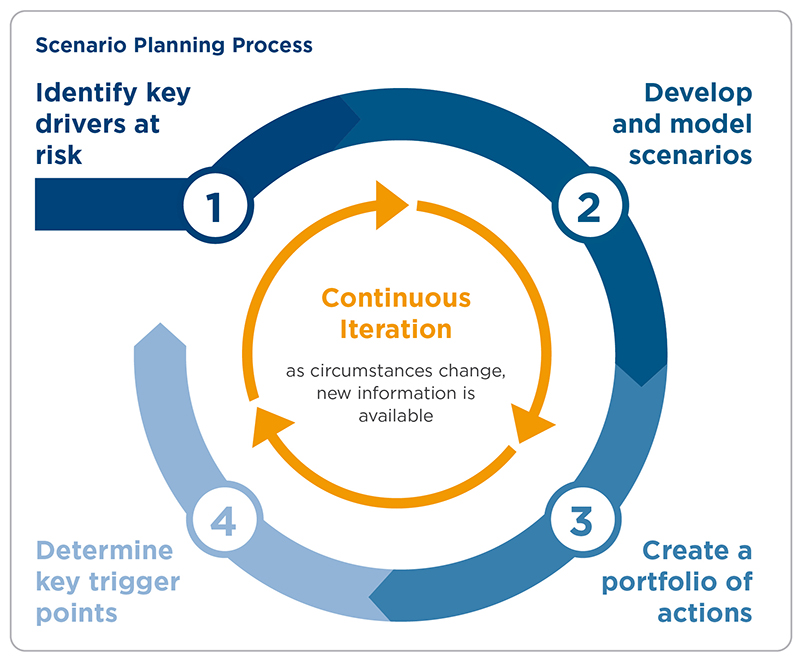
An excellent article with tools is at Bridgespan: Nonprofit Scenario Planning During a Crisis. (Image is from Bridgespan.)

What seemed to be very helpful was to work through the best case, worst case, and most likely case. This gave firm(er) footing to move forward, aiming for the worst case until indications showed otherwise.

Nonprofits could get pandemic relief funding, so it was prudent to keep employees so that the organization could immediately ramp back up.

Just knowing what the worst case looks like enabled the executives to have a comfort level on how to move forward. Notice how Bridgespan a table with best case on the left. Maybe cut executive salaries by 15%. In the worst case, layoffs and cut executive salaries by 30%.

Hall & Hinkelman (2017) have written on scenario planning and they discuss how scenario planning is different from the worst-case analysis above. Scenario planning would have story lines that discuss how the official future could suddenly change. It would have early warning signs that would indicate that “we’re not in Kansas anymore, Toto”. Then it would actually have ways of dealing with the new reality, essentially contingency plans.

Would the scenario planning have a pandemic as its signals and signposts (as Shell refers to early warning signs)? Probably not. However, there would be something that results in a major freeze up or collapse in the economy.  The early warning signs may still work well; and the contingency plans would usually work pretty well.

Effective scenario planning would put any organization weeks, if not months, ahead of the competition. It would also place them in a great position to adjust, adapt and survive.

Scenario Planning for Nonprofits should be more than worst, best and most-likely case. But no matter what you call the scenario planning tool, it is very helpful during times of uncertainty.

Similar Posts

  • |

    Smile no more. Amazon.

    For years credit cards, Amazon, eBay and others have had “affinity” programs where a charity could be designated to receive money associated with normal sales activities. In the case of Amazon, Amazon Smile program, 0.5% of qualifying sales goes to your favorite charity. “You shop. Amazon Gives.” The program has been very successful growing since…

  • | | | | | | | | | | | | | |

    A Tale of Two Reports: Why the DOE’s Climate Assessment Demands a Reality Check

    A Working Group (of 5) Came out with a “Moderate” Report for the DOE A new DOE climate report has been released by the U.S. Department of Energy at the end of July 2025. Authored by five “independent” researchers, it concludes that the economic damages of climate change may be less than believed and that…

  • | | | |

    States Act Forcibly to Halt or Limit Patent Trolls

    The patent troll condition -as identified- is a relatively new phenomenon/hot spot in the IP world, perhaps one or two decades old.  To be sure, there were isolated cases of troll-like behavior as far back as the 1970s, but nothing like the scope, intensity and frequency of the past several years.  Today’s trolls not only…

  • | | | | | | | |

    Western Monarch Butterfly Day: A Warning Signal from Pollinators in Crisis

    Why the parallel decline of monarch butterflies and bees is more than an environmental story—it is a strategic sustainability signal. Western Monarch Butterfly Day arrives at a sobering moment. Western monarch populations continue to struggle for survival, while beekeepers across North America report that this was a particularly bad honey bee season, marked by elevated…

  • | | | | | | | | | |

    Kids teaching kids: Personal Finance with Easy Peasy Finance

    There’s something magical about kids talking to kids about critically important issues. In this case, Personal Finance. Life can be hard in many cases, and financial issues amplify them 10-fold. Wouldn’t it be nice if kids learned young about personal finance a little at a time in short 2-minute burst from a whiz-kid finance guru?…

  • | | | | | | | | | | |

    Why Are We Treating Soil Like Dirt? – World Soil Day 2025 and the Future Beneath Our Feet

    We walk on it, pave over it, and only notice it when it clogs our tires or messes up our boots. We call it dirt, sweep it off our floors, and complain when it sticks to our shoes. But this same “dirt” quietly grows 95% of our food, filters our water, and stores more carbon…